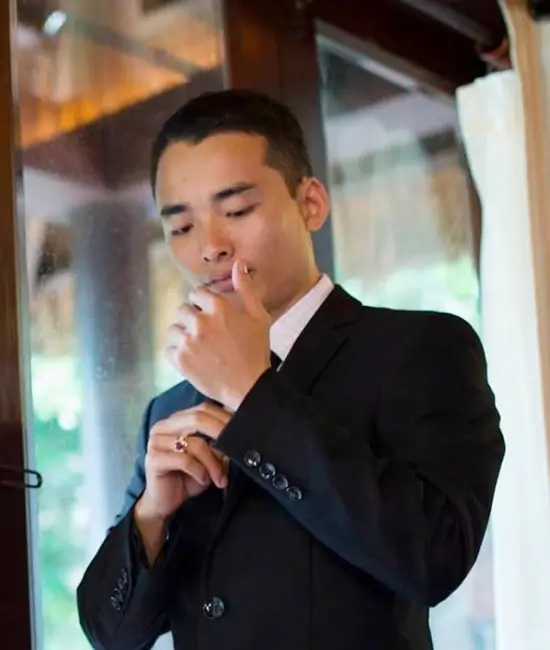
Vietnamese names run in the reverse of the Western order, and the good news is that the rule itself is simple. A woman's name and a man's name are built the same way: family name, then middle name, then given name. The last word is the personal one, and it is the one people use. Underneath that sits a set of kinship terms embedded in the grammar, because Vietnamese has no neutral word for you. So Lê Thị Lam is chị Lam, not Ms Lê, and Nguyễn Ngọc Minh is anh Minh, never Mr Nguyễn. This guide covers name order, middle names, why so many people carry the surname Nguyễn, how an introduction actually works, and the passport problem that catches travelers at the visa stage.
Name Order: The Last Word Is the One People Use
A Vietnamese name has three parts and they come in the order family name, middle name, given name. Nguyễn Ngọc Minh is a man whose family name is Nguyễn and whose personal name is Minh. Lê Thị Lam is a woman whose family name is Lê and whose personal name is Lam. Some people have two middle syllables, a few have none, and compound given names like Thu Hà behave as a single unit. The constant is the position: the personal name sits at the end (Cultural Atlas).
| Element | In Nguyễn Ngọc Minh | What It Does | Do You Use It? |
|---|---|---|---|
| Family name | Nguyễn | Inherited, conventionally from the father | No, never on its own |
| Middle name | Ngọc | Distinguishes, marks a generation, sometimes signals gender | Only inside the full written name |
| Given name | Minh | The personal name, chosen for its meaning | Yes, with a kinship term: anh Minh |
| Full name as printed | NGUYEN NGOC MINH | The passport version, Vietnamese order, no diacritics | Copy it onto forms exactly as printed |
Two things follow that catch visitors out. The first is that Vietnamese people in international settings often reverse the order for you, writing Minh Nguyen on an email signature or a conference badge. That is a courtesy extended to foreign forms, not a change of the name, and the same person's passport still reads the other way round. The second is that women do not take a husband's family name. There is no legal name change on marriage, a wife keeps her own family name for life, and children conventionally take the father's, so a Vietnamese family of three may carry two surnames between them.
Forms of Address: Given Name Plus a Kinship Term
Here is the single most useful correction on this page. Vietnamese people are addressed by their given name, and that name almost never travels alone. It carries a kinship term chosen by the relationship between the two speakers: em for someone younger, anh for a man of roughly your age or a little older, chị for a woman in the same bracket, cô and chú for people around your parents' age, bác for anyone older than that, ông and bà for grandparent age. So it is anh Minh, chị Lam, cô Hương. Not Mr Nguyễn, and not Minh on its own in most settings.
These are not family words reserved for relatives. They are how you speak to a waiter, a driver, a colleague and a stranger in a shop, because Vietnamese has no neutral second person. They also come in reciprocal pairs, so choosing what to call the other person chooses what you call yourself: with anh or chị you become em, with bác or ông you become cháu in the north or con in the south. Tôi is the one first-person word that sits outside the system, and it reads as neutral and slightly cool rather than polite, which is fine in a transaction and chilly with someone being warm to you. We have the full grid in our guide to saying hello in Vietnamese.
The practical version for a visitor is short. If they look younger than you, em. If they look roughly your age, anh for a man and chị for a woman. If they look older than your parents, bác, which is gender neutral and therefore the safest guess in the set. Nobody expects a foreigner to get this right, and approximate use is received warmly.
⚠️ Be careful with em if you are a man. Em is also what a woman calls herself when speaking to her boyfriend or husband, so a man using em to a woman of roughly his own age can sound like flirting rather than friendliness. Use chị for any adult woman who is not visibly younger than you, and you will never trip over this.
Nguyễn: A Dynastic Artifact, Not a Vietnamese Smith
Nguyễn is the most common Vietnamese family name by a very wide margin, and about a dozen surnames including Trần, Lê, Phạm, Hoàng or Huỳnh, Phan, Vũ or Võ, Đặng, Bùi, Đỗ, Ngô and Dương cover most of the rest of the population. The comparison people reach for is Smith, and it is the wrong one. Smith accumulated slowly out of an occupation. Nguyễn accumulated politically, in waves, as a survival strategy.
The commonly cited sequence runs like this. Descendants of the Lý were pushed onto the surname Nguyễn after the Trần took power in the 13th century. Hồ descendants adopted it after 1407. Then the Nguyễn dynasty, which ruled from 1802 to 1945, made the name simultaneously prestigious and safe to hold, and colonial-era registration froze in place names that had been fluid for centuries (Nguyễn Việt Khoa, Toward an Onomastic Account of Vietnamese Surnames). Vulnerable families took the ruling house's name because a name was protection.
What that means in practice is that a shared surname in Vietnam tells you about dynastic history rather than about ancestry. Two people called Nguyễn are no more likely to be related than two strangers, which is also why the surname does almost no identifying work and why nobody uses it to address anyone.
⚠️ Treat the 40% figure as an estimate rather than a statistic. You will see it everywhere, including in otherwise careful reference sources, but we could not find a census table or a peer-reviewed count behind it, and the same search turns up an unsourced claim that the share had fallen to around 30% by 2023. Nguyễn is dominant. The precise number is folklore.
Middle Names: What Thị and Văn Signal, and How Far It Holds
The middle name does the work that a common surname cannot. It separates people who share a family name and a given name, it honors ancestors, and in many families it marks a generation, so that cousins born in the same cohort carry the same middle syllable and lineage position is readable straight off the name. Some families give every son one middle name and every daughter another.
The convention most often quoted to visitors is the gendered pair: Thị in a woman's name, Văn in a man's. It is real and it has a long history, and other male middles like Hữu, Đức, Xuân, Quang and Công work the same way. But it is not what every Vietnamese person is called, and Thị in particular now reads as old-fashioned to many urban Vietnamese. Parents born since the 1990s have largely moved to aesthetic middle names like Ngọc, Minh, Khánh and Gia, or to two-syllable given names with no separable middle at all. Assuming that a Vietnamese woman must be Thị something is roughly like assuming an Englishwoman must be a Mary.
Given names themselves are ordinary vocabulary words with transparent meanings, which is the part that surprises English speakers most. Khiêm is modesty, An is peace, Dũng is courage, Hùng is heroic, Lan is orchid, Liên is lotus, Hương is fragrance, Thảo carries both herb and filial devotion. Many work for either sex. Parents are naming a quality rather than choosing a sound, and the meaning stays live for every Vietnamese speaker who hears it.
Diacritics: Why One Spelling Can Be Several Different Names
Vietnamese writes six tones with five marks plus the unmarked default, and the marks are not decoration. The textbook illustration is a single syllable carrying six meanings: ma is ghost, mà is but, má is cheek, mả is tomb, mã is code, mạ is a rice seedling (Kirby, Journal of the International Phonetic Association). Strip the marks and all six collapse into one string.
Names are ordinary words, so they collapse the same way. Written without diacritics, several genuinely different names become indistinguishable, and a Vietnamese reader looking at a bare Latin-alphabet spelling is often guessing between two or three possibilities. This is why Vietnamese friends will sometimes spell a name out loud with the tone names attached, and why a wedding invitation or a name card carries the marks even when a boarding pass cannot.
Two consequences follow for a visitor. Socially, nobody expects you to produce the tones, and no one will hold a flat pronunciation against you. Administratively, the version of a Vietnamese name that reaches a travel document is a lossy copy of the real one, which is where names stop being a cultural curiosity and start being a paperwork problem. If you want the tones themselves, we cover them alongside the words you will use most in our list of essential Vietnamese phrases.
Passports and Forms: Where Vietnamese Names Meet Western Software
A Vietnamese passport prints the name in Vietnamese order, family name first, and the machine-readable strip at the foot of the page drops every diacritic. So the document says NGUYEN NGOC MINH, and any system that assumes the last word is the surname will file that person under Minh, or split the name into a first name of Nguyen and a last name of Ngoc Minh. Airlines, hotel systems and visa forms all do it, and a mismatch between a booking and a passport is the sort of small error that turns into a long conversation at a counter.
The rule that resolves all of it is to copy the name exactly as the passport data page prints it, in the same order, without tidying it into Western form. That applies to Vietnamese names and to yours. Vietnam's eVisa application asks you to upload an image of your passport data page along with a portrait photograph, and the details you type are checked against that page by the Immigration Department (Vietnam National Electronic Visa portal). What matters is not the correct spelling of your name. It is the printed spelling.
⚠️ Your visa has to match your passport, character for character. Middle names included, hyphens included, and in the same field order the passport uses. A visa issued in a name that differs from the passport it is checked against is a problem at the border rather than a typo, and corrections are much easier before submission than after. Our guide to the Vietnam visa approval letter and stamping fee covers what the issued document should look like.
Age First: How a Vietnamese Introduction Actually Works
If someone asks your age within a minute of meeting you, that is not nosiness. It is a functional question. Until they know whether you are older or younger than they are, they cannot choose a pronoun, and without a pronoun they cannot build a sentence about you. Answer it, and ask it back, which is entirely acceptable in return.
Two more rules govern the opening moments, and visitors miss both. The younger person greets first, and this is held firmly enough that Hanoi informants in one study described a young person who waits to be greeted as vô lễ, discourteous (Nguyen, Asian Social Science). If you look younger than the person in front of you, open. And when you walk into a room, greet in order of age, oldest first, before you work through everyone else (Cultural Atlas). The same study recorded informants quoting the proverb lời chào cao hơn mâm cỗ, a greeting is worth more than a feast, which tells you how much weight the ritual carries.
The physical side is undramatic. The bow is a slight inclination of the head from the shoulders, deeper for someone senior, not a bow from the waist. Handshakes are normal between men and in urban and business settings, with a second hand laid on top as a mark of extra respect, though rural people are often less comfortable with the gesture, so offer rather than insist. With women, let her put her hand out first. Hugging is for close relationships, and an embrace on first meeting lands as strange.
Office and Street: Address at Work, and the Two-Handed Habit
Formality in Vietnam does not work by switching from a given name to a surname. It works by switching the kinship term. In a meeting the same person you would call anh Minh over coffee may be ông Minh, but the given name stays put, and job titles attach to it the same way. Expect an organization to run on relative age as much as on the org chart: seniority, seating and speaking order tend to follow it, and a younger colleague will address an older one as anh or chị whatever the reporting line says. Our post on living and working in Vietnam goes into the workplace side properly.
The gesture that goes with all of this is two hands. Business cards, documents, money, gifts, a cup of tea, anything handed to or taken from someone older or senior gets both hands, or your right hand supported at the forearm by your left (Cultural Atlas). One hand is not a crime, it is just visibly casual, and the two-handed version is noticed every time. A card handed over with two hands and read for a moment before it goes in your pocket does more for a first meeting than anything you could say.
Socially the register loosens a long way, and younger urban Vietnamese use bare given names among themselves far more freely than the rulebook suggests, particularly with colleagues of their own age. What does not loosen is face: public criticism is the expensive mistake in Vietnamese working life, and a problem raised privately gets solved faster than the same problem raised in the room. Our guide to Vietnamese etiquette, the dos and the don'ts sorts the rules that matter from the ones that do not.
A Few Parting Notes on Names and Manners
Two footnotes worth carrying. Many Vietnamese people have a home name, tên ở nhà, used only by family, and it is often deliberately plain or unglamorous, with a folk rationale about not drawing the attention of malevolent spirits to a child. Being told someone's home name is a sign of closeness. Using it uninvited is not. And everything on this page describes Kinh majority practice. Vietnam recognizes 54 ethnic groups, and naming conventions among Cham, Khmer, Hmong and other communities follow their own systems rather than a variant of this one.
You will get some of it wrong, and that turns out not to matter much. The corrections that pay off are small: use the last word of the name, put anh or chị in front of it, hand things over with two hands, and let the marks on a written name stand. Vietnamese people are generous about foreign attempts at all of this, and visible effort is worth far more than precision. If you want the wider picture, our guide to Vietnamese culture and traditions is the place to start, and Vietnamese funeral and wedding traditions covers the ceremonies where family names and ancestor lines come to the surface.
One last thing to retire, because it is the mistake this page exists to fix. Mr Nguyen is wrong twice over. It picks the family name, which is not a form of address in Vietnamese at all, and it picks the single most common family name in the country, which identifies nobody.